
The History of Afternoon Tea

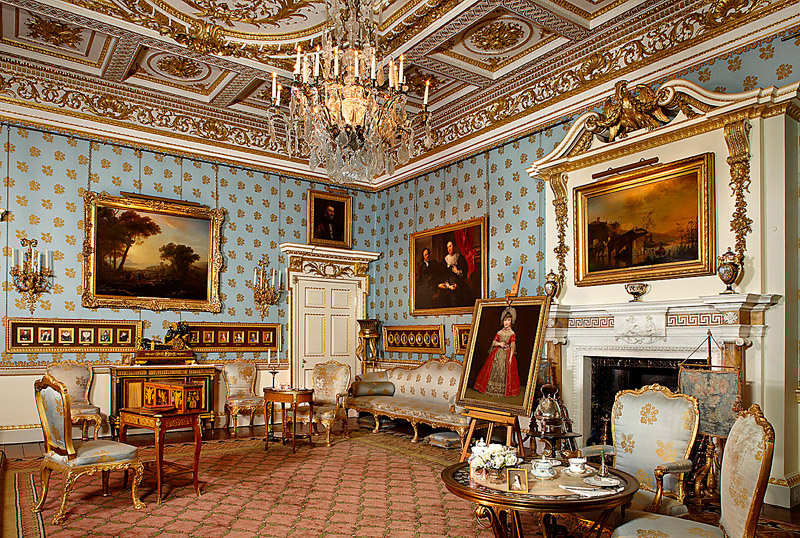
The Blue Drawing Room where Anna Russell entertained guests for Afternoon Te

The Blue Drawing Room where Anna Russell entertained guests for Afternoon Tea (image credit: Woburn Abbey)

First let’s distinguish between the idea of tea drinking in England, and the more elaborate ritual of taking afternoon tea (a light meal), which evolved much later.

When and how did tea become so popular in England? Portugal was probably most responsible. In 1662, when Charles II married a member of the Portuguese royal family, Catherine of Braganza, she brought tea with her as part of her dowry, and tea soon became the official court beverage in the 1660’s. At that time, tea was scarce, expensive and highly taxed – a rare luxury good that only the aristocracy and upper classes could afford.

The powerful East India Trading Company began providing King Charles II with small gifts of tea from China for Catherine in order to curry his favor and perhaps win special rights and privileges for the company, which may have included a near monopoly on tea imported from China.    Continue reading

High Tea at Fortnum and Mason, London

St. James's Restaurant at Fortnum and Mason ©Fortnum and Mason

St. James’s Restaurant at Fortnum and Mason ©Fortnum and Mason

When I arrived at Fortnum and Mason, it was after sundown and the right time for High Tea. High Tea is served later in the day and is a more substantial meal than the lighter fare that is commonly associated with afternoon tea.  After entering through F&M’s oak doors on Piccadilly, I took the lift up to the 4th Floor St. James’s, a full service restaurant that serves meals and teas of all kinds. The restaurant is light, airy, has a quiet ambiance, tables set a good distance apart, live piano music, and for a lucky few, tables next to the windows overlooking Piccadilly below.  Even though I requested one, they were all reserved for a function later that evening.

After opening on this spot in 1707 as a small grocery shop, Fortnum and Mason have been doing business at 181 Piccadilly for over 300 years.  They have a long history of dealing in exotic imported foods and other fine goods, including full leaf teas of all kinds, and have earned numerous Royal Warrants. From the beginning, Fortnum and Mason have sold tea to anyone who asked, a novel idea in the 1700’s when tea drinking was limited mostly to the aristocracy. Continue reading

Afternoon Tea at Brown’s Hotel, London

Brown's Hotel English Tea Room © Rocco Forte Collection

Brown’s Hotel English Tea Room © Rocco Forte Collection

Although it was dark and overcast on this late November day in London, the air was unusually warm at 57F / 14C.  Walking up Albemarle Street in the heart of Mayfair, I came to the unmistakable entrance to Brown’s Hotel.  Built in 1837 by James Brown and his wife, Sarah, who were formerly butler and maid to Lord and Lady Byron, it was the first hotel in London that catered to “genteel” folk.

As of 2003, Brown’s is owned by The Rocco Forte Collection which invested 24 million GBP in refurbishments after acquiring this luxury hotel.

On a historical note, Alexander Graham Bell stayed here in 1876 to demonstrate his new invention, the telephone.  The English Tea Room is where Rudyard Kipling wrote much of his famous novel, The Jungle Book.  It is also believed that Agatha Christie wrote her novel (At Bertram’s Hotel) while at Brown’s Hotel and modeled the story after the hotel. United States Presidents Theodore and Franklin Roosevelt both selected Brown’s Hotel for their honeymoons. Continue reading

Afternoon Tea at The Ritz Carlton, Chicago

Lobby of The Ritz Carlton, Chicago (image courtesy of The Ritz Carlton)

Lobby of The Ritz Carlton, Chicago (image courtesy of The Ritz Carlton)

Afternoon Tea at The Ritz Carlton, Chicago reminds me of spending a relaxing afternoon in someone’s luxurious parlor or living room. The mood is unhurried, the atmosphere is elegant, and the overstuffed sofas and chairs just make you want to stay and never leave.  In some ways, it reminds me of The Gallery at The George V in Paris, one of my all time favorite places for afternoon tea.

Tea is served in The Ritz Carlton Hotel’s lobby located on the 12th floor of Water Tower Place in Chicago, a high rise building on The Magnificent Mile that includes retail stores on the lower floors, the Ritz Carlton Hotel on the mid floors and luxury condominiums with views of Lake Michigan on the upper floors. You’re close to the high energy of the city yet, at the same time, twelve floors above it in a soundproof oasis. (This is also where U.S. television personality Oprah Winfrey lives in Chicago.) Continue reading

What Is Clotted Cream?

Tea time, with scones, clotted cream and jam

Tea time, with scones, clotted cream and jam

First of all, it’s clotted, not whipped.  Secondly, it’s a rich and creamy dairy product that most people associate with England, but is now available widely around the world.  Thirdly, it’s a luxury item that is usually spread on scones, desserts and fresh fruit, especially at afternoon tea taken in the English tradition.

Clotted cream is made by pouring fresh milk into a pan and then letting it sit for several hours, allowing the cream to rise to the top.  Then it’s simmered over low heat until clots form on the surface, trapping the cream inside. The clots are then skimmed off to make clotted cream.  The signature golden hue comes from the butterfat content in the whole milk.

Some sources claim clotted cream first originated as early as 16th century England, while others indicate the 19th century.  In any case, it seems clear that it arose as a method for preserving excess milk supplies, at least for a few extra days. Since that time, the process for making it has barely changed. Continue reading

Afternoon Tea at The Waldorf Astoria, New York City

Afternoon Tea on The Cocktail Terrace at The Waldorf Astoria (image courtesy of The Waldorf Astoria)

Afternoon Tea on The Cocktail Terrace at The Waldorf Astoria (image courtesy of The Waldorf Astoria)

If there ever was a luxury hotel that embodies New York,  it’s the Waldorf Astoria. Of course it’s a landmark luxury hotel, but it’s steeped in so much history that it’s difficult to talk about New York without mentioning the Waldorf.  From Guy Lombardo’s annual New Year’s celebrations broadcast from the Grand Ballroom to guests including heads of state and Hollywood royalty too numerous to mention, the hotel has a long and storied past.

Historically, The Waldorf is responsible for transforming the role of major urban hotels into establishments that do more than just provide temporary accommodations to travelers. These grand urban hotels were to become social centers in cities and prestigious destinations for visitors.  The Waldorf was also at the forefront of advancing the status of women by being one of the earliest to admit women singly, without escorts. Continue reading

Afternoon Tea at The Pierre, New York City

Afternoon Tea is served in The Pierre's 2E Lounge

Afternoon Tea is served in The Pierre’s 2E Lounge

Ah, The Pierre, a luxury hotel in New York City and one time home to actress Elizabeth Taylor, former Harrods owner Mohamed al-Fayed, and the French designer Yves Saint-Laurent.  Charles Pierre, an immigrant from Corsica, began in the restaurant business in New York and over the years established social ties with some of Wall Street’s largest financiers. In 1930, they joined together to form a venture to build The Pierre, a 42 story hotel on Fifth Avenue and east 61st Street, in Manhattan. The Great Depression doomed the prospects for this and many other hotels, and it was forced into bankruptcy in 1932.  J Paul Getty then purchased the building in 1938 and converted some of the hotel’s rooms into cooperative apartments. As of 2005, The Pierre is a Taj Hotel, a global chain of fine luxury hotels and resorts.  Continue reading